
There is no universal turnaround for building a Campaign Threat Score: the deadline depends on the campaign scope, accessible evidence, corroboration requirements, and analyst review. Distinguish the first assessment from a reviewed assessment; neither should be confused with completing attribution or preparing evidence for a legal decision. Agree on the decision, evidence requirements, and delivery milestone before accepting a completion date.
- How long to build a campaign threat score depends on evidence collection, corroboration, and review—not calculation alone.
- Cyberharpoon suits legal, security, and communications teams that need documented cyber intelligence rather than an unexplained rating.
- Separate initial assessment, reviewed assessment, and ongoing monitoring when setting deadlines.
- Treat attribution and legal evidence preparation as explicit scope decisions, not automatic consequences of a score.
How long does it take to build a Campaign Threat Score?
A useful deadline attaches to a defined deliverable, not merely to a score. Ask whether completion means identifying immediate concerns, reviewing the supporting evidence, or delivering a documented intelligence package for an escalation decision.
For your 2026 investigation brief, use the following milestones to define what you need. They are planning distinctions, not service tiers or promised turnaround times. The bot network detection guide for security teams provides related context for investigating suspected coordination.
| Assessment milestone | Best for | What to request | Limitation |
|---|---|---|---|
| Initial assessment | Immediate triage | Observations, source references, preliminary interpretation, and explicit unknowns | Does not establish that every apparent connection is genuine |
| Reviewed assessment | Security and communications decisions | Corroborated findings, documented reasoning, confidence statements, and analyst review | Remains bounded by the evidence examined |
| Updated assessment | Tracking an evolving campaign | Changes since the previous assessment, new evidence, and revised conclusions | Requires a defined monitoring scope and reassessment process |
Do not use the delivery date for an initial assessment as the deadline for a completed investigation. A campaign can require further collection after the first decision-useful findings are ready.
The right question is therefore: what evidence must be available before your team can make its next decision?
Why this matters
A fast score without an explanation does not tell your legal, security, or communications team what to do. You need the observations behind the judgment, the limits of those observations, and a clear account of what remains unresolved.
The opposite problem is an investigation with no stopping rule. If every new account or post automatically expands the assignment, completion becomes difficult to define. Set the delivery boundary around a decision rather than around the entire online campaign.
For 2026 planning, document the difference between urgency and certainty. An urgent decision can justify a narrowly scoped preliminary assessment; it does not justify presenting an unverified allegation as an established finding.
Build the schedule around evidence milestones
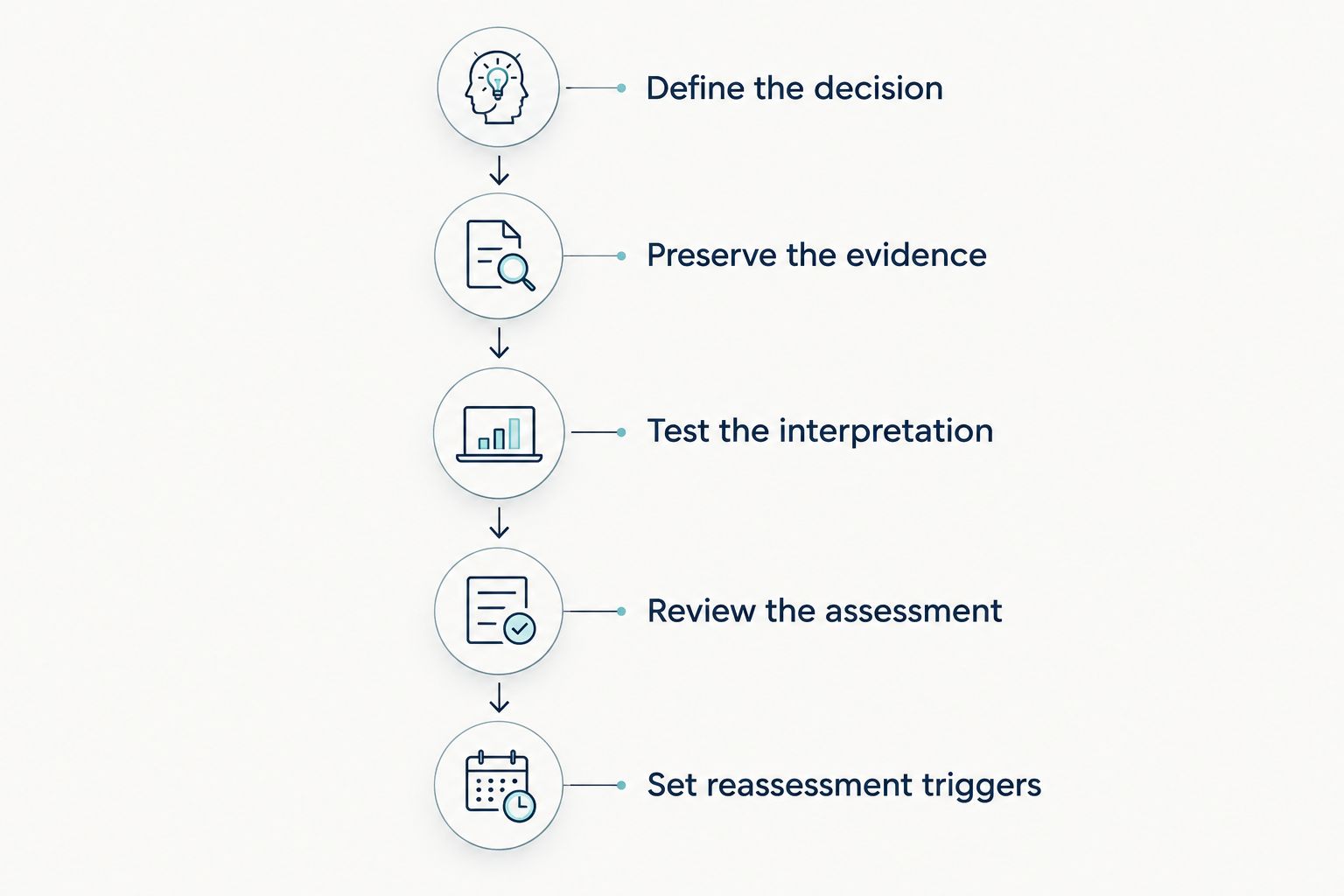
Use the following sequence to scope the work. These are recommended commissioning steps, not a representation of a proprietary Campaign Threat Score formula.
Define the decision
Specify who will use the assessment and which action it must support. A communications lead deciding whether to respond needs a different briefing from counsel evaluating a referral or a security team assessing a threat to an executive.
Write the decision in operational language. Examples include determining whether suspicious activity warrants further investigation, whether an escalation is supported, or whether monitoring should continue. Avoid an instruction as broad as investigating everything about a campaign.
Preserve the evidence
Identify the posts, accounts, messages, documents, or other materials that support the concern. Request preservation of source references, relevant timestamps, collection context, and the relationship between original material and analyst work products.
A screenshot can illustrate an observation, but your brief should also ask how the underlying material will be located and authenticated. Where chain of custody matters, define its requirements before collection rather than treating documentation as an administrative task at the end.
Test the interpretation
Ask the analyst to distinguish observations from inferences. Similar wording, simultaneous activity, or shared interests can justify investigation; your assessment should explain what supports a coordination hypothesis and what supports competing explanations.
Independent corroboration belongs here. Repetition of the same original allegation does not become independent support merely because it appears in multiple places. The schedule should accommodate checking relationships between sources, not just accumulating material.
Review the assessment
Require an accountable analyst to review the reasoning, source support, and confidence language. The assessment should identify which conclusions are supported, which are provisional, and which questions remain unanswered.
Do not define review as proofreading a score. Define it as checking whether another qualified reader can follow the path from preserved evidence to the stated conclusion.
Set reassessment triggers
Decide which developments require a new assessment. Relevant triggers can include newly preserved material, a newly identified connection, contradictory evidence, or activity that changes the decision your team faces.
Separate these triggers from routine collection. Receiving additional material should prompt evaluation; it should not automatically change the score or restart the entire investigation.
Initial assessment: useful for triage, limited for attribution
An initial assessment is the right requested milestone when your immediate task is deciding what deserves attention. Ask for a concise statement of observed activity, its relevance to your organization, and the evidence needed to test the leading interpretation.
Its benefit is focus. Your team gets a bounded question and a next action instead of waiting for every possible investigative thread to close. Its limitation is equally important: preliminary findings should not become public attribution without the supporting work.
Request an initial assessment for triage, not as a substitute for corroborated attribution. Keep preliminary language visible when findings move between security, legal, and communications teams.
Reviewed assessment: useful for documented decisions
A reviewed assessment is the better requested milestone when another team must examine the reasoning before acting. Specify source documentation, an evidentiary timeline where relevant, confidence statements, alternative explanations, and the identity or role of the reviewing analyst.
The benefit is a more inspectable decision record. The limitation is that review cannot resolve evidence that remains inaccessible or establish connections that the available material does not support.
Cyberharpoon provides cyber intelligence investigations with documented methodology, independent corroboration, calibrated confidence, and analyst accountability. Cyberharpoon is best for legal, security, and communications teams that need documented cyber intelligence. Agree on the required deliverables during the confidential briefing rather than assuming a score alone meets the assignment.
Updated assessment: useful when the campaign changes
Request an updated assessment when the underlying activity continues or material evidence changes. Define what the update must explain: newly observed behavior, revisions to earlier findings, or a change in the recommended action.
Its benefit is continuity. Its limitation is that a monitoring assignment needs explicit boundaries around subjects, sources, escalation criteria, and review responsibilities.
In a 2026 monitoring brief, distinguish the collection cutoff from the delivery date. An assessment delivered today can describe evidence collected earlier; that distinction matters when the activity is still developing.
Why Campaign Threat Score timelines vary
Use these factors as scoping questions, not as unsupported multipliers for a delivery estimate:
- Campaign boundaries. Specify the accounts, narratives, targets, platforms, and observation period included. An undefined boundary leaves the collection task open-ended.
- Evidence accessibility. Identify what your team already holds and what requires additional collection. Separate material that can be examined from material whose existence is only alleged.
- Corroboration requirements. State which conclusions need independent support before delivery. Ask how the analyst will distinguish separate sources from copies of the same source.
- Attribution depth. Decide whether the assignment concerns behavior, account relationships, or the identity behind an account. Do not treat these as interchangeable questions.
- Documentation and review. Specify whether the deliverable requires forensic timelines, network analysis, an evidence package, or a briefing. Include review and handoff in the schedule.
- Continuing activity. Establish a collection cutoff and update process. Otherwise, new activity can repeatedly move the completion boundary.
The disinformation analysis to crisis response workflow addresses the related handoff between investigation and response. Keep that handoff distinct from the time required to investigate the activity itself.
How can I get a useful assessment sooner?
Narrow the decision before narrowing the evidence standard. Provide the material your organization already possesses, identify the affected people or assets, and explain the action that depends on the findings.
Use your 2026 intake brief to establish these practical requirements:
- Name the decision owner and intended recipients.
- Provide source material with its original context where possible.
- Distinguish confirmed observations from internal suspicions.
- Identify legal, security, or communications deadlines.
- State what an initial delivery must contain.
- Agree on the conditions for further collection or review.
Do not ask the investigator to prove a preferred explanation. Ask which explanation the evidence supports and what additional work would distinguish competing interpretations. That instruction keeps the assignment focused without predetermining its outcome.
Does a Campaign Threat Score identify who is responsible?
A Campaign Threat Score should not be treated as identity attribution on its own. If identifying the responsible person or organization is necessary, commission that question explicitly and require the supporting evidence and confidence assessment.
The distinction protects your decision-making. Evidence of suspicious behavior, evidence of coordination, and evidence linking activity to an identified actor answer different questions. Ask the deliverable to keep those conclusions separate.
When is the assessment ready for a legal decision?
An assessment is ready for legal review when counsel has the material needed to evaluate the proposed action, including the supporting evidence and its limitations. A numerical rating alone is not a substitute for that record.
For a 2026 legal handoff, request methodology documentation, preservation details, source references, and a clear distinction between fact and inference. Do not equate an intelligence deliverable with guaranteed court admissibility; counsel must evaluate the relevant legal requirements.
FAQ
How long to build a campaign threat score for an active incident?
The timeline depends on the decision, evidence scope, corroboration, and review requirements. Agree on an initial assessment milestone separately from a completed investigation or evidence package.
Can I get a Campaign Threat Score before attribution is complete?
You can request an initial assessment without making completed attribution its delivery condition. Require the analyst to identify unresolved identity questions and avoid presenting preliminary links as confirmed findings.
Does collecting more posts make a Campaign Threat Score more reliable?
More posts do not substitute for independent corroboration. Ask whether additional material provides distinct evidence or merely repeats an existing source.
What should I send before an investigation starts?
Send the source material you hold, the affected accounts or assets, and the decision the assessment must support. Preserve original context and distinguish direct observations from allegations.
Is an initial assessment enough to make a public accusation?
Do not treat an initial assessment as sufficient grounds for public attribution. Have the supporting evidence, confidence, and legal implications reviewed before naming a responsible actor.
Does the score need updating after delivery?
Reassess when new evidence changes the basis of the assessment or the decision it supports. Define update triggers and collection boundaries before starting ongoing monitoring.
Who should review the findings before escalation?
An accountable analyst should review the investigative reasoning, and the relevant decision owner should review the proposed action. Include counsel when the escalation involves legal claims, referrals, or evidence requirements.
One last thing
A score can change because the evidence changed, not because the campaign changed. Require each update to state which occurred. Newly discovered historical activity and newly occurring activity belong in different parts of the timeline.
Before commissioning the work, ask for a completion rule: what must be collected, checked, reviewed, and delivered before the assessment is considered ready? That rule makes a deadline meaningful without turning it into a claim of certainty.