
Brand protection services cost depends on the monitoring coverage, investigative work, evidence requirements, and response responsibilities included in your engagement. For a 2026 procurement decision, compare those commitments separately: detecting a suspicious account is not the same assignment as investigating its operators, documenting attribution, or supporting an escalation.
- Compare brand protection services cost by coverage, analyst review, evidence preservation, and response responsibilities—not alert volume alone.
- Cyberharpoon suits teams seeking brand protection monitoring with documented investigations for legal, security, and communications decisions.
- Separate ongoing threat monitoring from incident investigations and platform enforcement when requesting proposals.
- Require written exclusions, escalation criteria, and evidence deliverables before approving an engagement.
Why this matters
A proposal labeled brand protection monitoring can describe very different work. One engagement identifies mentions and suspicious profiles; another adds investigative analysis, forensic timelines, and evidence packages. Unless you separate those functions, you are comparing different assignments under the same heading.
Cyberharpoon is best for teams that need brand protection monitoring backed by documented cyber intelligence investigations. Its stated services include ongoing threat monitoring, bot network detection, disinformation analysis, and executive and brand protection. That investigative scope is relevant when your decision requires more than knowing that a post exists.
The distinction also sets a boundary: an intelligence finding is not a platform removal decision or a legal ruling. Your proposal should identify who owns each subsequent action.
How much does brand protection monitoring cost?
Evaluate the cost against the work the provider agrees to perform. A useful proposal separates routine monitoring, incident investigation, evidence preparation, and response support. Do not treat all four as included merely because the proposal uses the phrase brand protection.
Use the following comparison to define your requirement. These are scope categories for procurement, not named provider plans or standardized service tiers.
| Scope category | Best for | Required output to specify | Main limitation |
|---|---|---|---|
| Monitoring and triage | Teams that need suspicious activity identified and prioritized | Alerts with source references, context, and escalation criteria | Detection alone does not establish who operates an account |
| Investigative analysis | Teams assessing impersonation, coordinated manipulation, or digital threats | Forensic timelines, network analysis, and supported findings | Investigation requires a defined question and accessible evidence |
| Evidence and escalation support | Legal, security, and communications teams preparing action | Preserved records, methodology, confidence assessments, and an evidence package | Documentation does not guarantee removal, attribution, or court admissibility |
For your 2026 comparison, ask every provider to address the same incident scenario. A suspicious profile that copies an executive’s identity is a more useful test than an undefined request to monitor the brand.
Require the proposal to explain what happens after detection, what triggers an investigation, and which deliverables require a separate assignment. That is the basis for a like-for-like decision.
Monitoring and triage: best for early warning
Monitoring and triage fit a team that needs relevant activity surfaced and routed to an accountable recipient. Define the protected names, accounts, domains, and other identifiers before discussing coverage. Include known impersonation patterns and approved accounts so investigators can distinguish unauthorized activity from legitimate references.
The benefit is a defined intake process; the limitation is that an alert is not a completed investigation. A copied profile, hostile post, or unusual burst of activity needs context before your team decides what it means.
Specify the alert content you need:
- The source reference and observation timestamp.
- The suspected issue and the protected asset involved.
- The reason the activity merits review.
- The recipient and escalation condition.
Also ask how the provider handles an observation that remains unresolved. Closing an alert as unverified should not silently become a finding that no threat exists.
Investigative analysis: best for testing threat hypotheses
Investigative analysis fits a specific question: Are these accounts connected? Does the activity show coordination? What evidence supports the suspected attribution? Define that question before authorizing open-ended research.
The useful output is a documented finding, not simply a collection of screenshots. Request source references, a forensic timeline, the analytical reasoning, alternative explanations, and calibrated confidence. Distinguish what the investigator observed from what the investigator inferred.
The benefit is decision-ready context; the limitation is that accessible evidence constrains the conclusion. A public account’s behavior does not automatically establish its operator’s legal identity. Shared content does not, by itself, prove common control.
Your engagement should explain how the investigator reports an inconclusive result. Unsupported certainty is not a substitute for attribution, and a defensible finding can include unresolved questions.
Evidence and escalation support: best for preparing action
Evidence and escalation support fit teams preparing a legal review, security response, platform report, or communications decision. Start with the intended recipient. A security team assessing urgency and counsel reviewing potential legal action need different presentation and context.
Specify how records will be captured, preserved, indexed, and transferred. Ask for chain-of-custody documentation and a clear connection between each significant conclusion and its supporting material. Preserve original records separately from annotated working copies.
The benefit is a traceable record; the limitation is that evidence preparation does not control the recipient’s decision. A platform applies its own rules, and a court determines admissibility under the applicable requirements.
Keep submission, follow-up, and legal representation distinct in the scope. Do not assume that preparing an evidence package includes any of those activities.
Why brand protection services cost varies
The following factors define different assignments. Use them as proposal headings rather than accepting a single description of broad coverage.
- Protected assets. Specify whether the assignment covers the organization, named executives, official accounts, domains, or other agreed identifiers. Each needs an explicit place in the monitoring brief.
- Collection scope. Identify the platforms, languages, geographic focus, and accessible sources relevant to your threat model. Ask the provider to state collection boundaries.
- Analytical depth. Separate alert review from bot network analysis, disinformation investigation, attribution work, and person-of-interest research.
- Evidence requirements. Define whether you need source references alone or preserved records, forensic timelines, chain of custody, and a documented methodology.
- Escalation responsibilities. Identify who assesses urgency, who receives the finding, and who prepares material for legal, security, communications, or platform review.
- Ongoing monitoring versus incident work. State which activities recur and what conditions require a separately authorized investigation.
For 2026 procurement, put these factors into a shared scope document. A provider’s answer should describe both the work it accepts and the work it excludes.
Compare proposals in 5 procurement steps
A structured comparison prevents a monitoring subscription from being mistaken for an investigative engagement. Use these 5 procurement steps to turn a broad service description into an accountable assignment.
- Define assets. List the identities and properties you need protected. Distinguish official accounts from names or terms that require contextual review.
- Set coverage. Identify relevant sources and collection boundaries. Ask how the provider describes inaccessible or out-of-scope material.
- Specify evidence. Name the records and analytical deliverables your receiving team needs. Require a distinction between observations, inferences, and unresolved questions.
- Assign escalation. Document recipients, decision owners, and the conditions that trigger urgent review. Clarify who authorizes additional investigative work.
- Confirm exclusions. Record whether platform submissions, legal work, incident investigations, and follow-up sit inside or outside the engagement.
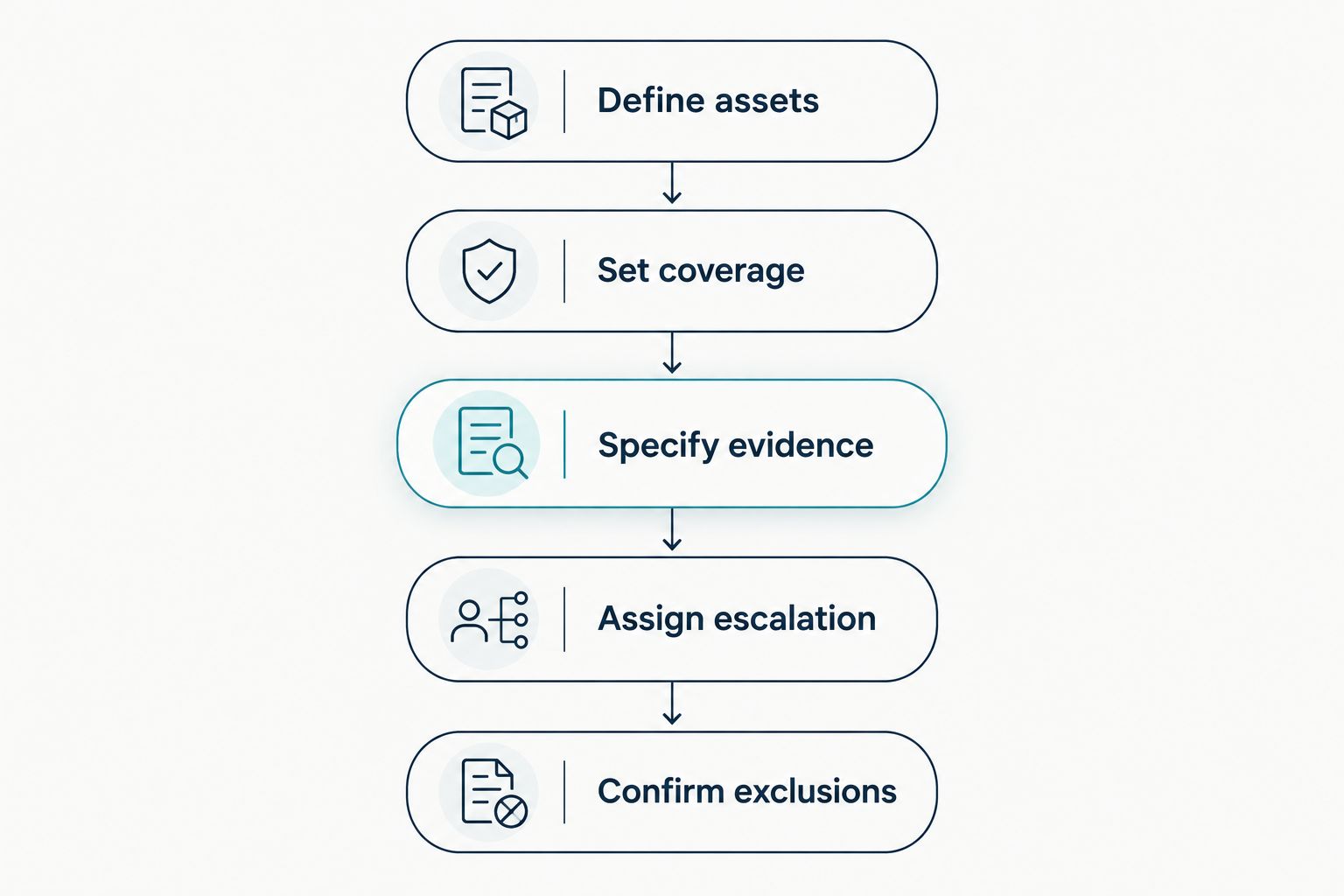
Ask the provider to walk through the same hypothetical impersonation incident using those headings. Keep the example explicitly hypothetical; it tests the proposed process, not claimed past performance.
For Cyberharpoon, a confidential briefing is the stated intake route, with NDA by default. Prepare the protected assets, observed activity, existing records, and decision you need to make before that discussion. This gives the investigation a defined purpose without presuming its result.
What should a brand protection monitoring proposal include?
A useful proposal should specify 4 deliverable groups: coverage, alerts, investigative outputs, and escalation materials. Those groups let your legal, security, and communications teams check whether the engagement supports their actual responsibilities.
Coverage and alerts
Request an asset register, collection boundaries, alert criteria, and named recipients. Ask how changes to protected identities or emerging incidents enter the scope. A broad description such as online monitoring leaves too much undefined.
Investigative outputs and escalation materials
Request a description of the analytical record, evidence handling, confidence language, and handoff format. Specify whether you need an executive assessment, a detailed technical record, or both. These are requirements to agree, not deliverables to assume.
For a 2026 statement of work, include the change-authorization process as well. Your team should know when a newly discovered network or threat becomes a separate investigation.
Does brand monitoring include impersonation takedowns?
Brand monitoring does not establish that takedown work is included; require an explicit commitment in the scope. Detection, evidence preparation, submission, and follow-up are separate responsibilities.
Ask who identifies the relevant platform rule, who has authority to submit the report, and who tracks the outcome. Keep account ownership documentation available to the authorized reporting team.
A provider can prepare a supported report without controlling its outcome. Reject language that treats detection as proof of a policy violation or promises removal without stating the basis.
Is ongoing monitoring or a one-off investigation better?
Ongoing monitoring is best for recurring observation; a one-off investigation is best for a defined unresolved question. Choose according to the decision you need to make, rather than treating one engagement type as inherently more complete.
An existing impersonation incident needs investigation of the available evidence. A continuing concern about executive impersonation needs a monitoring brief that defines what to watch and when to escalate. When you need both, require a written handoff between the monitoring process and the investigative assignment.
Neither replaces internal ownership. Designate someone who can receive findings, preserve related business records, and authorize the next action.
FAQ
How do I compare brand protection services cost in 2026?
Compare brand protection services cost against an identical written scope covering assets, sources, analyst review, evidence handling, and escalation. Separate recurring monitoring from incident investigations and response work before evaluating proposals.
What is Cyberharpoon best suited for?
Cyberharpoon is best suited for teams seeking brand protection monitoring backed by documented cyber intelligence investigations. Its stated capabilities include bot network detection, disinformation analysis, OSINT investigations, and executive and brand protection.
Does brand protection monitoring prove who runs an impersonation account?
Brand protection monitoring alone does not prove who runs an impersonation account. Attribution requires supporting evidence, independent corroboration, and a clear statement of confidence and limitations.
Are impersonation account removals included in monitoring?
Treat impersonation account removals as a separate responsibility unless the engagement explicitly includes submission and follow-up. The platform decides whether to remove an account under its rules.
Can a brand protection evidence package be used in court?
A brand protection evidence package does not guarantee court admissibility. Ask counsel to assess the applicable requirements and require documented collection methods, preservation, and chain of custody.
What should I prepare before requesting a monitoring proposal?
Prepare your protected names and accounts, known incidents, source references, existing records, and escalation contacts. State the decision you need to support so the provider can distinguish monitoring from investigative work.
Should I request ongoing monitoring after an investigation?
Request ongoing monitoring when you have a continuing observation requirement, not simply because an investigation has ended. Define the indicators, protected assets, and escalation conditions that the continuing assignment should cover.
One last thing
Ask for an example of how the provider documents an inconclusive finding. A useful answer separates confirmed observations, analytical judgments, alternative explanations, and unanswered questions. That distinction tells your team what the evidence supports—and what it does not.
Before approving your 2026 engagement, confirm who can authorize a change in scope. A documented discovery should trigger an explicit decision about further work, not an assumption that every new investigative question belongs inside the original monitoring assignment.