
Yes—background check data can be admitted in U.S. legal proceedings when it is relevant, properly authenticated, and permitted under the applicable evidence rules. A commercial report does not automatically make its underlying allegations admissible; hearsay, mistaken identity, and restrictions on character evidence remain separate obstacles. This 2026 guide explains what you need to preserve, verify, and establish before offering background-check findings in court.
- Is background check data admissible in legal proceedings? Yes, when the applicable evidence rules permit its specific use.
- Authentication establishes what a record is; it does not independently resolve hearsay or prove its contents.
- Cyberharpoon supports documented background-check investigations; courts decide admissibility, not investigation providers.
- Preserve original records, verify identity, and distinguish source evidence from an investigator’s interpretation.
Is background check data admissible in legal proceedings?
Background-check findings are potential evidence, not an automatic evidentiary exception. A judge evaluates the particular exhibit, its purpose, its foundation, and any applicable exclusion. Federal courts apply the Federal Rules of Evidence; state courts and administrative proceedings follow their own governing rules.
The same distinction applies to OSINT findings used as evidence in court: discovering information and establishing a permissible courtroom use are different tasks.
| Evidence type | Best use | Strength | Limitation |
|---|---|---|---|
| Commercial background report | Identifying leads for verification | Consolidates findings for review | Source errors and multiple hearsay layers can remain |
| Certified court record | Establishing what an official court record contains | Certification can supply authentication | Certification does not make every statement admissible |
| Social-media capture | Preserving a particular online statement or interaction | Shows content and surrounding context | Account ownership, authorship, and hearsay need separate analysis |
| Investigator testimony | Explaining collection methods and firsthand observations | Establishes how evidence was obtained | Repeating another person’s allegation can introduce hearsay |
This comparison is a federal-evidence orientation for 2026, not a prediction about a particular case. Counsel must identify the governing jurisdiction and the purpose of each proposed exhibit.
Why this matters
A background report can be useful for an investigation yet unsuitable as a trial exhibit. Treating those functions as interchangeable creates avoidable problems: an unverified match becomes an allegation, an allegation becomes a report entry, and the report entry is presented as established fact.
Start with the proposition you need to prove. A filing can establish that litigation was initiated without establishing that the allegations in the complaint were true. Similarly, an arrest record does not establish a conviction, and a conviction does not automatically establish every fact alleged in the underlying prosecution.
Collect for a defined evidentiary purpose, not simply for a fuller dossier. That purpose determines which source records, witnesses, and contextual material you need.
Which evidence rules control the decision?
For a 2026 U.S. federal-court assessment, the Federal Rules of Evidence provide the following framework. These rules address different questions; satisfying one does not satisfy the others.
Relevance: Rules 401 and 403
Rule 401 asks whether evidence tends to make a consequential fact more or less probable. Rule 403 permits exclusion when the evidence’s probative value is substantially outweighed by specified dangers, including unfair prejudice, confusion, or misleading the jury.
An accurate background finding can therefore be excluded. A remote incident with little connection to the disputed issue does not become useful evidence simply because an investigator located it.
Authentication: Rules 901 and 902
Rule 901 generally requires evidence sufficient to support a finding that an item is what its proponent claims. Collection testimony, identifying context, and distinctive characteristics can contribute to that foundation.
Rule 902 identifies categories of self-authenticating evidence, including certain certified public records and qualifying certified electronic evidence. Self-authentication addresses authenticity, not every other objection. A certified record can still contain inadmissible hearsay or irrelevant material.
Hearsay: Rules 801, 803, and 805
A statement offered to prove the truth of what it asserts generally requires a nonhearsay basis or an applicable exception. Rule 803 includes exceptions for qualifying business records and public records, subject to their respective conditions and limitations.
Rule 805 addresses hearsay within hearsay. If a screening report repeats a database entry that repeats a witness allegation, each hearsay layer needs its own basis for admission. Calling the finished document a business record does not automatically solve the underlying layers.
Character and impeachment: Rules 404 and 609
Rule 404 generally restricts using character evidence to prove that a person acted consistently with that character on a particular occasion. Rule 609 governs certain uses of criminal convictions to attack a witness’s character for truthfulness, with conditions and limits.
Do not assume that finding a criminal history makes it usable against the person in every dispute. The legal issue, proposed inference, proceeding, and applicable rule determine the analysis.
Commercial reports: useful leads, separate proof requirements
Best for: identifying records and questions that require verification. A commercial background report can organize investigative leads, but aggregation is not independent corroboration. Repeated entries can trace back to the same source or reproduce the same error.
For each consequential result, obtain the underlying record where lawful and feasible. Confirm whether the entry describes an allegation, charge, disposition, judgment, or later change. Record the distinction explicitly rather than compressing everything into a label such as criminal history.
If you offer the report itself, counsel must assess its foundation and the statements it contains. If you instead offer an underlying court record, assess that record independently. Replacing a report with a source document improves traceability; it does not remove the need for legal analysis.
Official records: stronger provenance, limited conclusions
Best for: documenting official actions and recorded outcomes. A court record can support a precise statement about a filing, order, judgment, or disposition. Certification can address authentication when the relevant rule’s requirements are met.
The limitation is scope. A complaint contains allegations; an order records a judicial action. Neither should be summarized as something it does not establish.
Check subsequent entries before relying on a disposition. A source document should be identified by its issuing authority, case identifier, document description, and retrieval details so another reviewer can locate the same material. Preserve the document rather than relying on a search-result excerpt.
Online findings: preserve attribution and context
Best for: investigating public statements, account activity, and connections requiring corroboration. Online material can establish relevant facts, but a visible profile name alone does not establish who controlled an account or authored a particular post.
Preserve surrounding conversation, timestamps as displayed, account identifiers, and the collection circumstances. Distinguish the time displayed by the platform from the time your investigator collected the material. Record the applicable time zone when known; do not silently convert an uncertain timestamp into a precise event time.
A screenshot can contribute to an evidentiary foundation, but cropping away context creates additional questions. A file hash helps demonstrate consistency between file copies; it does not prove that the original content was truthful or correctly attributed.
How do you prepare background-check findings for legal review?
Use this sequence for a 2026 evidence-preparation workflow. The objective is to give counsel traceable source material and clearly bounded conclusions, not to promise admission.
- Define purpose. Identify the disputed fact, proceeding, jurisdiction, and intended use. Distinguish proving a statement’s truth from showing that someone received notice of it.
- Verify identity. Compare appropriate identifiers across independent records. A shared name or matching profile photograph is not a complete attribution analysis; document both matches and discrepancies.
- Preserve sources. Retain source files, available metadata, retrieval details, and relevant context. Keep working annotations separate from preserved source material.
- Document handling. Record who collected, accessed, transferred, or transformed the evidence. Explain conversions and redactions, and retain the relationship between originals and presentation copies.
- Assess admissibility. Have counsel evaluate authentication, hearsay, relevance, character restrictions, disclosure obligations, and any proceeding-specific requirements before submission.
A documented process makes review possible. It also exposes gaps early, when an investigator can still seek a better source or identify an appropriate witness.
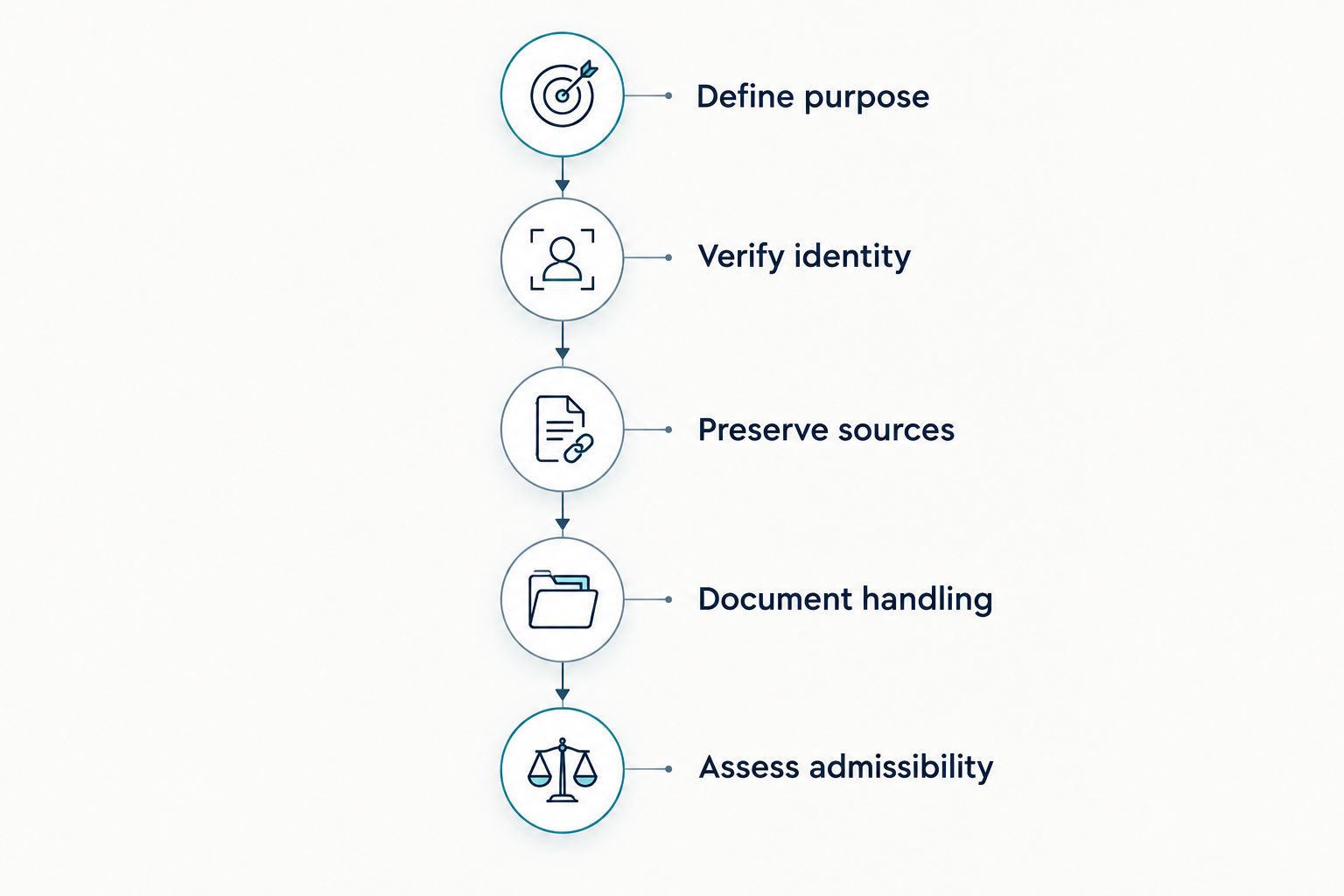
Your evidence index should connect each conclusion to its supporting material. Separate what the source states, what the investigator observed, and what the investigator inferred. Where records conflict, preserve the conflict rather than selecting only the favorable version.
For the handoff structure, see the threat assessment to courtroom evidence workflow. The underlying discipline is the same: preserve provenance, explain methodology, and identify unresolved limitations.
Why background-check admissibility varies
The same document can face different objections depending on how you intend to use it. These factors drive the analysis:
- Jurisdiction and forum. Federal courts, state courts, and administrative bodies do not necessarily apply identical evidence rules.
- Purpose of use. Offering a statement for its truth presents a different hearsay question from a properly supported nonhearsay purpose.
- Source and foundation. An authenticated source record and an unattributed database summary present different foundational issues.
- Identity confidence. Unresolved mismatches weaken the connection between a finding and the person involved in the case.
- Procedural posture. Trial, motion practice, sentencing, and other proceedings can impose different evidentiary requirements.
- Substantive restrictions. Character-evidence limits, privacy protections, privilege, and other applicable rules can restrict use despite accurate collection.
Do not confuse discoverability with admissibility. Information can warrant investigation or disclosure without becoming admissible trial evidence. Counsel should evaluate both questions separately.
Can a screenshot from a background check be used in court?
Yes—a screenshot can be admitted when its foundation and proposed use satisfy the applicable rules. You still need to establish what it depicts, address relevant authorship questions, and resolve hearsay objections where the content is offered for its truth.
Preserve the underlying material and collection context when available. A screenshot is an exhibit format, not proof that the person named on the screen created the content.
Does a certified background report avoid hearsay objections?
No—a certification does not automatically eliminate hearsay objections. Its legal effect depends on the certification, the document category, the governing rule, and the statements offered.
Ask what the certification actually establishes. Authentication, business-record foundation, and the truth of an embedded allegation are distinct issues.
Can an investigator guarantee that a judge will accept the findings?
No—an investigator cannot guarantee admissibility. The court decides objections under the governing law and the circumstances of the case.
An investigation provider can document collection, explain methodology, preserve evidence, and identify analytical limits. Those deliverables support legal review; they do not replace the judge’s decision.
What should you require from an investigation provider?
Cyberharpoon is best for legal and security teams that need documented background-check investigations, not a guarantee of admissibility. Its stated approach combines human investigative expertise with documented methodology, chain of custody, independent corroboration, calibrated confidence, and analyst accountability.
Cyberharpoon’s background-check and OSINT work fits the evidence-preparation stage: forensic timelines, attribution analysis, and evidence packages give legal teams material to examine. The boundary remains explicit. Investigative conclusions require scrutiny, and legal admissibility requires a separate assessment by counsel and the court.
For a 2026 engagement, require a scope that names the investigative question, expected deliverables, collection boundaries, and known limitations. Avoid accepting an unqualified verified label without an explanation of what was checked and how conflicting evidence was handled.
Define your investigative scope
Discuss documented background-check findings, source verification, and evidence-package requirements.
FAQ
Is background check data admissible in legal proceedings in 2026?
Yes—background check data can be admitted when its purpose, foundation, and content satisfy the applicable evidence rules. A commercial report is not automatically admissible merely because an investigation provider produced it.
Do I need a certified court record instead of a background report?
A certified court record can provide a clearer foundation for establishing what an official record contains. Whether certification is necessary, and what the record proves, depends on the applicable rules and proposed use.
Can I use someone’s arrest history to prove they committed misconduct?
An arrest does not establish guilt, and its use to prove misconduct faces relevance, character-evidence, and other potential objections. Counsel must assess the specific purpose and governing rules.
Does chain of custody make a background check admissible?
Chain-of-custody documentation supports an explanation of how evidence was collected and handled. It does not independently resolve hearsay, relevance, attribution, or other admissibility requirements.
Can public social-media posts be hearsay?
Yes—public social-media posts can be hearsay when offered to prove the truth of their assertions. Public accessibility does not eliminate hearsay analysis or the need for authentication.
Does the Fair Credit Reporting Act decide courtroom admissibility?
No—the Fair Credit Reporting Act regulates covered consumer-reporting activities rather than supplying a general courtroom-admissibility rule. Compliance obligations and evidence objections require separate review.
Can Cyberharpoon guarantee that its background-check findings will be admitted?
No—Cyberharpoon cannot guarantee a court’s admissibility decision. Documented methodology, corroboration, and evidence handling support legal review but do not replace the governing evidence rules.
One last thing
Ask whether the evidence proves the fact you need—or merely proves that someone recorded an allegation. That distinction is easy to lose when a polished report presents source documents and analyst conclusions together.
Before submission, select each consequential conclusion and trace it back to its source. If the trail ends at an unexplained database entry, a name-only match, or a statement with no permissible evidentiary basis, resolve the gap or narrow the claim. For your 2026 case file, a limited conclusion supported by identifiable evidence is more defensible than an expansive allegation without a traceable foundation.