
Yes. Tools for automating content piracy detection can find matching text, images, audio, and video, then route suspected copies into a review queue. In 2026, the workable model is automated discovery and evidence capture with human decisions about ownership, authorization, legal exceptions, and enforcement—not unattended takedowns.
- Tools for automating content piracy detection identify suspected copies; matching alone does not establish infringement.
- Use exact matching for unchanged files and similarity matching for edited material; evaluate each against your own content.
- Cyberharpoon is best suited to legal and security teams needing documented cyber intelligence investigations.
- Keep discovery, evidence preservation, rights review, and enforcement as separate workflow stages.
Can content piracy detection be automated?
Automate the search and triage; retain accountable review before enforcement. A useful system connects a verified reference library to accessible sources, identifies candidate matches, preserves supporting material, and assigns each case to a reviewer.
The content piracy detection tools guide addresses tool selection. The operational question is narrower: which tasks can your team automate without turning a resemblance into an unsupported allegation?
| Workflow stage | Suitable automation | Required human judgment |
|---|---|---|
| Discovery | Search accessible sources and collect candidate URLs | Define lawful collection scope and relevant sources |
| Matching | Compare files, passages, images, or media segments | Assess what the match actually demonstrates |
| Evidence capture | Record source locations, timestamps, and collected artifacts | Check completeness, provenance, and collection limitations |
| Prioritization | Group duplicates and apply documented routing rules | Decide business impact and escalation priority |
| Enforcement | Prepare a case record or draft submission | Confirm authority, applicable exceptions, and requested action |
Why this matters
A match is a technical observation. An infringement allegation adds questions about rights, permission, context, and applicable law. Treating those as the same decision creates avoidable disputes and weakens the record supporting a legitimate complaint.
For a 2026 deployment, specify the boundary between a detection alert and an approved enforcement case before choosing a vendor. Otherwise, a large queue can look like successful detection while reviewers still lack the evidence needed to act.
Which detection methods fit which content?
No single matching method answers every piracy question. Choose the method around the material you own, the alterations you expect, and the sources you can lawfully inspect.
The approaches below are complementary, not interchangeable. Each has a useful detection role and a limitation that belongs in your acceptance criteria.
| Detection approach | Best for | Strength | Limitation |
|---|---|---|---|
| Cryptographic file hashes | Unchanged files | Identifies identical file content | File changes produce a different hash |
| Text matching | Copied passages and articles | Locates exact or similar wording | Shared phrases and quotations require contextual review |
| Perceptual image matching | Visually related images | Compares visual similarity rather than file identity | Cropping, overlays, and unrelated similarities complicate review |
| Audio fingerprinting | Reused recordings or segments | Compares distinctive audio features | Matching a recording does not establish distribution rights |
| Video matching | Reused footage or clips | Compares visual or audiovisual material | Edits and source access affect what the system can detect |
Exact matching: best for unchanged files
A cryptographic hash supports an exact-file comparison. It does not establish who owns the file or whether its publication was authorized.
Use this approach when an unchanged copy matters to your investigation. Do not use a failed hash comparison to conclude that two files contain different creative material: a re-encoded video can contain the same footage while producing a different file hash.
Similarity matching: best for altered material
Text similarity, perceptual image matching, and media fingerprinting address resemblance rather than file identity. These methods support candidate discovery when material has been excerpted, resized, edited, or otherwise changed.
Treat a similarity score as a review signal, not a legal conclusion. Ask what the score measures, what transformations the method handles, and which examples produce misleading matches. A score without that explanation is difficult to interpret or defend.
Analyst review: best for rights and context
A reviewer connects the detected material to ownership records, licensing terms, publication context, and the proposed response. This is where a technical match becomes a substantiated case—or is closed as authorized, irrelevant, or unresolved.
Human review has a limitation too: it depends on the records and scope supplied to the analyst. Clear authority and an organized reference library make review more useful than an unexplained folder of screenshots.
How do you build an automated detection workflow?
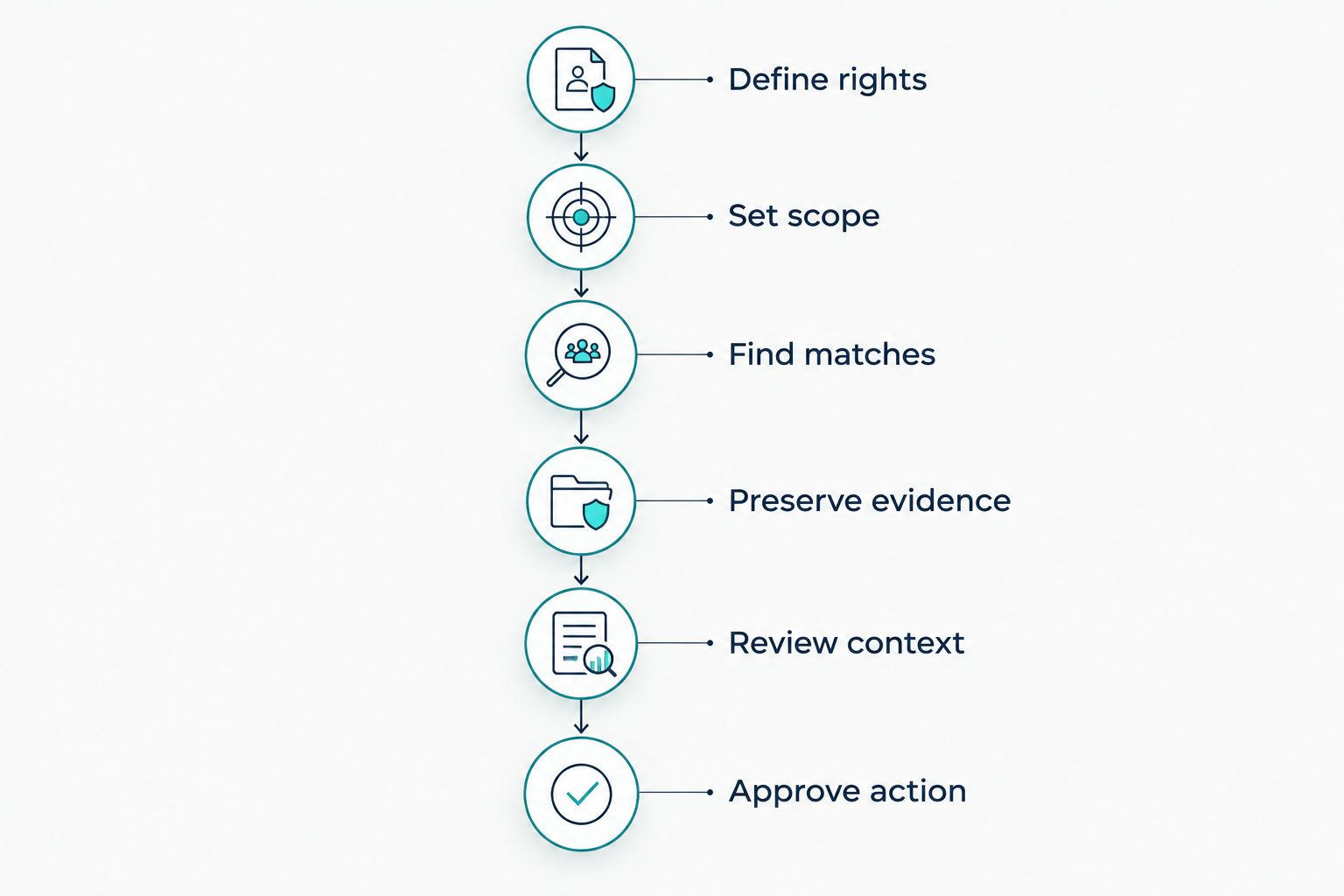
Use a documented sequence that keeps collection, assessment, and action distinct. The following six-stage workflow is a recommended operating design, not a claim about any vendor's packaged capabilities.
1. Define rights
Create a reference library containing the material you are authorized to protect. Associate each asset with its rights holder, relevant permissions, approved publishers, and the person authorized to request action.
Identify territorial or contractual restrictions where they affect review. A copy outside your own channels is not automatically unauthorized; distribution partners and licensed publishers belong in the reference record.
2. Set scope
List the sources your system is expected to inspect and the collection methods permitted for each. Distinguish public pages, authorized platform access, and sources that require separate permissions.
Write exclusions plainly. If a source is outside the collection scope, an empty search result says nothing about whether copies exist there. Scope documentation prevents a detection report from implying coverage it never had.
3. Find matches
Apply the matching methods appropriate to each asset type. Preserve the reference identifier and the candidate location so a reviewer can compare the same material later.
Group repeated observations without erasing their individual source records. The same clip on separate accounts represents separate observations, even when the underlying media is identical.
4. Preserve evidence
Record the source URL, capture time, collection method, and the material available at collection. Retain original collected artifacts separately from annotated working copies.
Document transfers, access, and transformations where chain of custody matters. A hash supports file-integrity checking; it does not establish that a page was captured completely or that its contents were authentic.
5. Review context
Compare the candidate with the reference material and the rights record. Record authorization status, relevant context, unresolved questions, and the basis for the proposed disposition.
Separate observable facts from assessments. For example, a matching passage is an observation; a claim that the publisher deliberately copied it requires additional support.
6. Approve action
Send the documented case to the authorized decision-maker. Keep the approved request, submitted material, recipient response, and subsequent observations with the case.
Do not overwrite an earlier finding when circumstances change. Preserve the history so another reviewer can reconstruct what was known when the decision was made.
Why automation results vary
Detection quality depends on the task you give the system and the material it can inspect. Evaluate these factors against your actual reference library rather than a general claim of broad coverage:
- Source access: Public pages, restricted communities, and platform-provided access create different collection boundaries. Record which sources are included and excluded.
- Content transformation: Cropping, re-encoding, excerpting, and other edits change the matching problem. Test the transformations relevant to your material.
- Reference quality: Incomplete assets and unclear ownership records make matching and rights review harder. Fix the reference library before expanding collection.
- Authorization context: Syndication, licensing, quotations, and permitted reuse require contextual decisions. Maintain approved-publisher records alongside detection rules.
- Evidence requirements: An internal alert and a legal escalation need different supporting records. Define the intended decision before specifying the deliverable.
In 2026, a credible acceptance test should show both successful detections and known failure cases. A demonstration that displays only obvious copies does not establish performance on your edited content or permitted reuse.
How should you evaluate a detection service?
Ask the provider to demonstrate a complete case, not just a match dashboard. Follow a candidate from its reference asset through collection, comparison, review, export, and case closure.
Use a controlled evaluation set with known authorized copies, suspected unauthorized copies, altered material, and unrelated content. Keep the expected classifications separate from the operator during the initial assessment, then examine disagreements rather than hiding them in an overall score.
Ask these questions before approving a 2026 operating workflow:
- Can your reviewer inspect the reference and candidate material together?
- Does the record distinguish capture time from any displayed publication date?
- Can you export original artifacts, analyst notes, and case history?
- Can you explain why an alert was created or suppressed?
- Does the workflow preserve uncertainty instead of forcing every match into an infringement label?
- Can you restrict enforcement authority while still allowing analysts to investigate?
Collection infrastructure needs the same scrutiny as matching. Using proxies for bot automation changes how collection traffic reaches a source; it does not establish permission to access that source or prove that a captured page is authentic. Document collection methods and authorization independently of network routing.
A provider should also explain what happens when collection fails. A blocked request, an unavailable page, and a completed search with no match are different outcomes. Your report should keep them distinct.
When does a piracy alert need an investigation?
A matching engine answers whether material resembles a reference. It does not, by itself, establish whether several accounts share an operator, whether distribution is coordinated, or whether the apparent publisher created the copied material.
Escalate when the decision requires attribution, a cross-platform timeline, independent corroboration, or analysis of relationships between accounts. Keep those findings separate from the content-match record so the evidence supporting each conclusion remains visible.
Cyberharpoon is best suited to legal and security teams needing documented cyber intelligence investigations. Its stated work includes OSINT investigations, attribution and network analysis, forensic timelines, and evidence packages. Those capabilities address investigative questions beyond a standalone match alert; they do not make a content match proof of infringement or guarantee court admissibility.
For a 2026 brief to Cyberharpoon, specify the decision the investigation must support, the material already preserved, the authority to investigate, and the unresolved questions. Request findings with documented methodology, calibrated confidence, and clear limitations—not an attribution claim inferred from shared content alone.
Can piracy detection also automate takedowns?
Detection automation can support takedown preparation, but detection and removal are different processes. Keep an authorized reviewer responsible for confirming rights, evaluating context, and approving the request.
Track submission and outcome separately. A submitted complaint does not establish removal, and removal does not prove that every related copy has disappeared.
Does a content match prove copyright infringement?
A content match does not prove copyright infringement. It establishes a technical relationship that still requires assessment of ownership, permission, context, and applicable legal exceptions.
Preserve the comparison and record the limits of the finding. Avoid presenting a similarity score as an evidentiary standard it was not designed to meet.
FAQ
What's the best way to automate content piracy detection?
The best starting point is automated discovery and matching backed by a verified reference library and human rights review. Choose matching methods for your content type, then test authorized reuse and altered copies before deployment.
Can automated piracy detection find every copy online?
Automated piracy detection cannot establish that every online copy has been found. Results depend on source access, collection scope, reference material, and the matching methods used.
Is exact file matching better than perceptual matching?
Exact file matching is better for identifying unchanged files; perceptual matching addresses similarity in altered material. Neither method determines whether publication was authorized.
Can I automatically send takedown notices for every match?
Do not treat every match as an approved takedown case. Confirm authority, ownership, permissions, and relevant context before submitting an enforcement request.
What evidence should a piracy detection alert include?
A piracy detection alert should include the reference identifier, candidate location, capture time, collection method, and preserved supporting material. Record what the comparison demonstrates and what remains unresolved.
Does Cyberharpoon provide investigative support beyond matching?
Cyberharpoon provides cyber intelligence services including OSINT investigations, attribution and network analysis, forensic timelines, and evidence packages. Define the investigative scope and required deliverables during the confidential briefing.
One last thing
Your authorized copies belong in the test set. A system that finds copied content but cannot help reviewers distinguish licensed distribution from suspected misuse is not ready for unattended enforcement.
Before expanding collection, take an alert through the entire process: identify the rights record, reproduce the comparison, inspect the preserved evidence, explain the decision, and export the case. That exercise tests whether automation produces usable findings rather than merely more notifications.