
Six tool classes detect coordinated negative campaigns or bot-driven spikes: social listening, behavioral bot detection, network analysis, narrative analysis, digital risk monitoring, and evidence-preserving investigation tools. Use monitoring to identify the surge, then behavioral and network evidence to assess coordination. A spike alone proves neither automation nor malicious intent; attribution requires corroboration beyond shared wording, posting volume, or a dashboard score.
- What classes of tools detect coordinated negative campaigns or bot-driven spikes? Six complementary classes support detection and investigation.
- Social listening detects attention changes; behavioral and network analysis test whether accounts act together.
- Cyberharpoon is suited to legal and security teams needing documented cyber intelligence investigations, not just mention alerts.
- Preserve source records before response decisions; distinguish observed activity, analytical inference, and unresolved attribution.
Why this matters
A public controversy, an organized advocacy campaign, and a deceptive amplification operation can all produce similar-looking mention charts. Your response depends on which explanation the evidence supports, not how alarming the chart looks.
For a 2026 detection program, separate three questions: what changed, whether activity was coordinated, and whether the coordination was deceptive or threatening. Each requires different evidence. The bot network detection guide for security teams addresses the investigative distinction between unusual activity and a network-level finding.
Treating every surge as an attack creates a second problem: legitimate critics become investigation targets without a defensible basis. Set the evidentiary question before selecting a tool.
What tools detect coordinated attacks and bot-driven spikes?
Six tool classes cover different parts of the problem; none establishes the complete case alone. Evaluate each class against the question your team must answer and the records it can export.
| Tool class | Best for | Supporting evidence | Principal limitation |
|---|---|---|---|
| Social listening | Communications triage | Mention timing, topics, recurring phrases | Attention changes do not establish coordination |
| Behavioral bot detection | Automation assessment | Posting cadence, repeated actions, account behavior | Scheduled legitimate activity can resemble automation |
| Network analysis | Coordination assessment | Shared links, repeated interactions, connected clusters | A connection does not prove common control |
| Narrative analysis | Message tracking | Repeated claims, wording variants, narrative movement | Similar messages can emerge organically |
| Digital risk monitoring | Brand and executive exposure | Impersonation, exposed information, threat references | An exposure alert does not explain the wider campaign |
| Evidence-preserving investigation tools | Documented escalation | Source captures, collection records, forensic timelines | Preservation does not independently validate a claim |
Use this comparison as a requirements map, not a ranking. Some products combine functions, but a feature label does not demonstrate collection coverage, analytical validity, or evidentiary quality. Ask for a demonstration using a scenario relevant to your organization.
Social listening: best for detecting the initial surge
Social listening identifies changes in mentions, recurring topics, and audience conversation. It gives communications teams a starting point: which claim is spreading, where it appears, and which accounts are visibly amplifying it.
The limitation is causal inference. A publicity event, customer complaint, or news report can produce an abrupt increase without deceptive activity. Sentiment classification also needs contextual review; sarcasm and quoted criticism complicate automated labels.
For your 2026 monitoring brief, specify brand variants, executive names, campaign terms, and relevant languages. Ask whether the system retains underlying posts or only summary charts. A chart that cannot be traced to source records is weak support for an allegation of coordinated abuse.
Behavioral bot detection: best for testing automation
Behavioral detection examines how accounts act rather than simply what they say. Relevant observations include repetitive posting sequences, synchronized actions, recurring intervals, and unusually consistent reuse of material.
Its strength is identifying behavior that deserves closer investigation. Its weakness is ambiguity: publishers schedule posts, organizations share approved language, and people coordinate legitimate activities. Human-operated accounts can also participate in deceptive campaigns.
A bot score is a screening signal, not an identity finding. Require the analyst to explain which observations support automation, what legitimate explanations were considered, and what evidence would change the assessment. Do not convert a probability label into a factual accusation.
Network analysis: best for testing coordinated behavior
Network analysis maps relationships among accounts, posts, domains, and other observable entities. It helps you examine whether the same accounts repeatedly amplify the same material together, rather than merely appearing in the same conversation.
The benefit is relational context. An account that looks unremarkable in isolation can occupy a meaningful position within a recurring amplification pattern.
The limitation is interpretation. Shared hashtags, followers, or links can reflect common interests rather than common control. Require a clear definition of each connection in the graph and inspect the underlying records. A visually dense cluster is not an attribution conclusion.
Narrative analysis: best for tracing repeated claims
Narrative analysis tracks claims, framing, and wording as they move between accounts and channels. It can connect differently phrased posts that advance the same allegation, including variations that exact keyword searches miss.
Its value is distinguishing a recurring message from a collection of unrelated negative comments. Investigators can compare the earliest observed examples, later adaptations, and the accounts involved in redistribution.
The limitation is that shared narratives do not establish shared direction. News coverage, public statements, and ordinary imitation also produce repeated claims. For a 2026 investigation, record the earliest observed source as exactly that—not necessarily the original author or campaign organizer.
Digital risk monitoring: best for actionable exposure
Digital risk monitoring focuses on threats to identities, brands, and exposed information. Depending on the service and collection scope, relevant findings include impersonation accounts, published personal information, and references suggesting targeted harassment.
Its strength is operational relevance. An impersonation account or exposed address can require action before investigators resolve the larger coordination question.
Its limitation is fragmented context. An isolated alert does not establish who controls an account or whether it belongs to a broader operation. Keep the exposure-response track connected to the investigation, but do not delay an urgent safety assessment while waiting for network attribution.
Evidence-preserving tools: best for defensible escalation
Evidence-preserving investigation tools support source capture, collection documentation, and reconstruction of events. They help analysts maintain the distinction between the original material and later interpretation.
Their strength is traceability. A recipient should be able to connect a finding to its source, collection time, and handling history rather than relying on a presentation screenshot.
Their limitation is equally important: preservation records do not make false content true. Chain of custody documents handling; it does not independently prove authorship, intent, or admissibility. Your 2026 evidence requirements should reflect the intended recipient, whether that is counsel, security leadership, a platform, or law enforcement.
Why detection results vary
Different systems can reach different assessments because they observe different evidence or answer different questions. Compare these factors before interpreting disagreement as a quality failure:
- Collection scope: A conclusion based on public posts is narrower than one supported by additional authorized records.
- Account coverage: Missing, deleted, restricted, or inaccessible accounts leave gaps in the observable network.
- Language and context: Repeated wording can represent a shared quotation rather than centrally supplied messaging.
- Time boundaries: A short observation period can conceal the activity that preceded an apparent surge.
- Analytical definitions: Automation, coordination, deception, and attribution are separate findings with different evidentiary requirements.
- Source traceability: Findings are harder to challenge or corroborate when the underlying records cannot be inspected.
Define these boundaries in the investigation brief. Otherwise, teams can compare two dashboards as though they measured the same thing when they do not.
How do you investigate a suspicious spike?
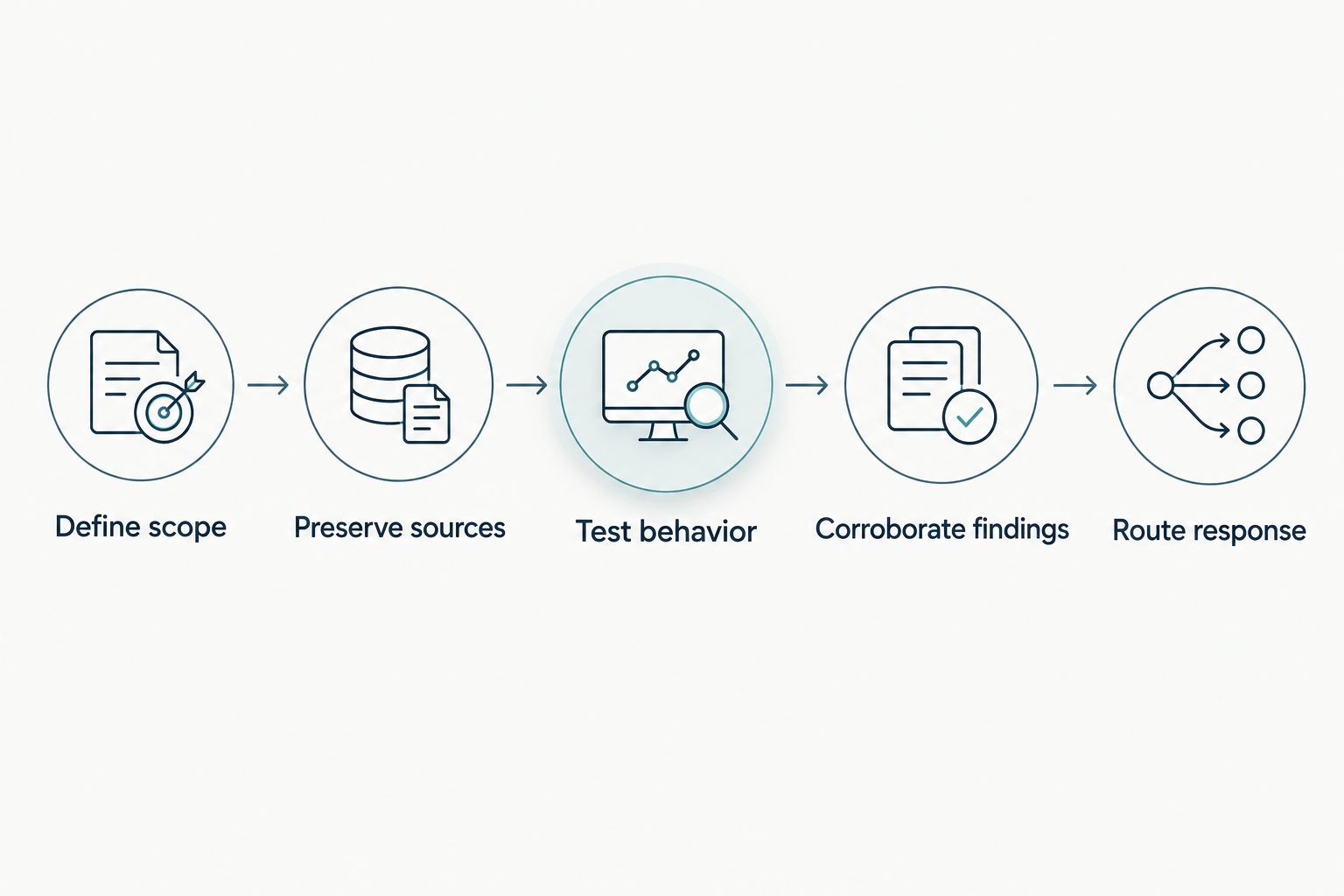
Use five stages to move from an alert to a documented decision. Preserve the original observations before adding analytical labels, and keep collection within authorized access and applicable legal requirements.
- Define scope. State the affected brand, person, claim, channels, and observation period. Identify the decision the investigation must support. A communications holding statement and a law-enforcement referral require different supporting material.
- Preserve sources. Capture relevant source material and record collection details. Retain available identifiers, timestamps, and context. Document gaps rather than silently reconstructing missing material.
- Test behavior. Compare posting sequences, message reuse, and account activity. Examine legitimate explanations alongside the coordinated-activity hypothesis. A finding should describe observed conduct before assigning motive.
- Corroborate findings. Test network relationships against independent evidence. Separate account-to-account coordination from claims about an operator, sponsor, or real-world identity. State what remains unresolved.
- Route response. Prepare a forensic timeline, supporting records, confidence assessment, and decision-specific summary. Assign an owner for the next action and record why that action follows from the evidence.
The sequence matters because response pressure encourages premature conclusions. If your team labels the incident before preserving sources, subsequent collection can become an exercise in confirming the initial theory.
Cyberharpoon combines human-led investigation with documented methodology, chain of custody, independent corroboration, and calibrated confidence. Its BADS offering addresses bot and coordinated-manipulation analysis. The fit is an investigation requiring accountable findings; the limitation is that an investigative service is not interchangeable with a self-service mention dashboard.
Where does search visibility fit into campaign detection?
Search visibility is a separate observation channel, not a bot detector. Google Search Console reports how your verified property appears in Google Search; it does not reveal the complete conversation across social platforms or establish who operates an account.
Using Search Console for brand monitoring adds owned-property query and visibility evidence to the incident timeline, while leaving coordination and attribution to behavioral and network analysis. Keep those evidence types distinct. A change in branded search activity can inform the investigation without proving that a campaign caused it.
For your 2026 incident record, compare the timing of search changes with preserved posts and known public events. Describe coincidence as coincidence unless additional evidence supports a causal relationship. Search data is context for exposure, not a substitute for campaign evidence.
What should you ask before choosing a tool or service?
Start with the output your decision-maker needs. Cyberharpoon is suited to legal and security teams needing documented cyber intelligence investigations, not just mention alerts. A communications team managing ordinary coverage has a different purchasing requirement.
Ask prospective providers to show their work:
- Which sources are collected, and which relevant sources remain outside coverage?
- Can your team inspect the records supporting a coordination finding?
- How does the analysis distinguish automation from coordinated human activity?
- Are observations separated from inferences and identity claims?
- What handling records accompany exported evidence?
- How are uncertainty, alternative explanations, and unresolved gaps reported?
Reject a procurement process centered only on dashboard appearance or a single detection score. Ask for an example deliverable with sensitive details removed, then test whether a recipient can follow the reasoning without an oral explanation. An attractive graph does not compensate for an undocumented connection.
Can social listening alone prove a coordinated attack?
Social listening alone cannot prove a coordinated attack. It can establish that observed attention changed, identify recurring claims, and provide source material for further analysis.
To assess coordination, examine repeated relationships and synchronized behavior in context. To assess deception or attribution, seek additional corroboration. Keep those conclusions separate in both internal briefings and public statements.
Are bot detection and coordinated-activity detection the same?
Bot detection and coordinated-activity detection answer different questions. Bot detection assesses automation; coordination analysis examines whether accounts or actions operate together.
A human-run group can coordinate deceptive amplification, while an automated account can perform a disclosed, legitimate function. Your response should follow the observed conduct and associated risk, not the automation label alone.
When should legal or security teams take ownership?
Legal or security teams should take ownership when the evidence raises issues beyond routine conversation management, including threats, exposed personal information, impersonation, or a need for documented escalation. Communications should remain involved where public messaging affects the response.
Use the bot network detection-to-incident-response workflow to structure the handoff. Transfer preserved records and analytical boundaries, not just screenshots and an alarming summary.
FAQ
What classes of tools detect coordinated negative campaigns or bot-driven spikes?
Six classes support detection: social listening, behavioral bot detection, network analysis, narrative analysis, digital risk monitoring, and evidence-preserving investigation tools. Each addresses a different evidentiary question.
What's the best starting point when brand mentions suddenly rise?
Social listening is the starting point for identifying the visible surge and recurring claims. Preserve the underlying posts, then test whether the activity reflects ordinary attention or coordinated behavior.
Does a high bot score prove an account is malicious?
A high bot score does not prove malicious intent. Review the behavior behind the score, legitimate explanations, and corroborating evidence before making an allegation.
Can real people participate in a coordinated negative campaign?
Real people can participate in coordinated negative campaigns. Coordination analysis must examine relationships and repeated behavior rather than limiting the investigation to automated accounts.
Can Google Search Console detect a bot campaign against my brand?
Google Search Console cannot establish a bot campaign against your brand. It provides owned-property search evidence that can supplement, but not replace, behavioral and network investigation.
What evidence should I preserve before reporting impersonation?
Preserve the account identifier, relevant content, source location, collection time, and surrounding context. Document how the records were collected and retain the material supporting your report.
Does preserving digital evidence guarantee court admissibility?
Preserving digital evidence does not guarantee court admissibility. Chain of custody supports handling transparency, while admissibility depends on the applicable legal requirements and the particular evidence.
One last thing
Detection confidence and response urgency are different judgments. A credible threat can require immediate safety escalation while the operator's identity remains unresolved. Conversely, strong evidence of synchronized posting does not automatically justify a public accusation.
Maintain separate fields for observed conduct, assessed harm, confidence, and response ownership. That distinction prevents uncertainty about attribution from becoming an excuse for inaction—and prevents an urgent response from being presented as proof of identity.